

Personal growth is the ongoing process of developing greater self-awareness, useful skills, healthier behaviors, clearer priorities, and more effective ways of responding to life.
It is not about becoming a completely different person. It is about understanding yourself better, learning from experience, and making deliberate changes that help you live according to what matters to you.
Psychological research increasingly treats personal growth as a gradual, dynamic process rather than a single achievement. A 2023 model of personal growth describes it as an ongoing process involving areas such as self-awareness, openness to change, responsibility, self-compassion, and relationships with others.
That makes personal growth much more practical than the usual self-help version of “become the best version of yourself.”
many a times growth means learning a new skill.
on many occassions it means changing a habit.
for sometimes it means admitting that an old approach no longer works.
And sometimes it simply means responding to the same difficult situation differently than you did a year ago.
Practical Ways to Encourage Personal Growth
You don’t need to redesign your entire life.
Start with one area where a small change could make a meaningful difference.
Understand Yourself Better
Personal growth becomes difficult when you don’t know what you are trying to change or why.
Start paying attention to your patterns.
Ask yourself:
- What situations repeatedly frustrate me?
- What do I keep postponing?
- When do I feel most focused?
- Which responsibilities drain me unnecessarily?
- What do I wish I handled differently?
- What values are important to me?
- Which habits make my days easier?
- Which habits repeatedly create problems?
You don’t need a complicated personality assessment.
A simple weekly reflection can reveal patterns.
The goal isn’t to criticize yourself.
It is to collect useful information about yourself.
Choose One Area to Work On
One of the easiest ways to make personal growth overwhelming is to try changing everything simultaneously.
You might decide to:
- Exercise every morning
- Read 50 books
- Wake up at 5 a.m.
- Learn a language
- Start a business
- Improve your relationships
- Become more productive
- Stop using social media
- Meditate every day
The list looks impressive.
It is also difficult to sustain.
Instead, choose one growth area for the next few weeks.
For example:
“I want to become better at communicating when I disagree with someone.”
That gives you a practical direction.
Once that behavior becomes more familiar, you can work on another area.
Turn Vague Goals Into Specific Behaviors
“I want to grow as a person” is meaningful but difficult to act on.
A better goal describes something observable.
Instead of:
“I want to become more confident.”
Try:
“I will speak at least once during each team meeting.”
Instead of:
“I want to read more.”
Try:
“I will read 10 pages before going to bed.”
Instead of:
“I want better relationships.”
Try:
“I will have one uninterrupted conversation with someone important to me each week.”
Goal-setting research suggests that setting goals can produce a small positive effect on behavior change, although the effect varies depending on the circumstances and the type of goal.
The practical lesson is simple:
Turn an intention into something you can actually observe yourself doing.
Use “If-Then” Plans
A goal tells you what you want.
An implementation intention tells you what you will do when a particular situation occurs.
For example:
If I finish breakfast, then I will spend 10 minutes planning my day.
Or:
If I feel myself becoming defensive during a disagreement, then I will pause before responding.
Or:
If I reach for social media while working, then I will put my phone away and return to the task.
Research on implementation intentions has found that specific “if-then” plans can help people translate intentions into goal-directed behavior.
This works particularly well for everyday personal growth because it connects an abstract intention to a real situation.
Learn Something That Makes Your Life Better
Personal growth isn’t only about changing your personality.
Sometimes the most valuable growth comes from learning a useful skill.
Consider skills such as:
- Writing
- Public speaking
- Listening
- Negotiation
- Budgeting
- Cooking
- Time management
- Digital organization
- Conflict resolution
- Critical thinking
- Emotional communication
- Basic technology skills
Choose skills that solve real problems in your current life.
For example, if work meetings regularly make you uncomfortable, learning presentation and communication skills may be more useful than consuming another ten motivational videos.
Useful knowledge becomes personal growth when you apply it.
Become More Comfortable With Reflection
Reflection isn’t the same as overthinking.
Overthinking repeatedly circles around a problem without producing useful action.
Reflection asks:
What happened, what can I learn from it, and what should I do differently?
After a difficult experience, try asking:
- What actually happened?
- Was it within my control?
- Any assumptions I made?
- What could I have handled differently?
- What will I do next time?
This turns experience into information.
You don’t need to analyze every event in your life. A few minutes of deliberate reflection after meaningful experiences can be enough to identify useful lessons.
Practice Self-Compassion Instead of Constant Self-Criticism
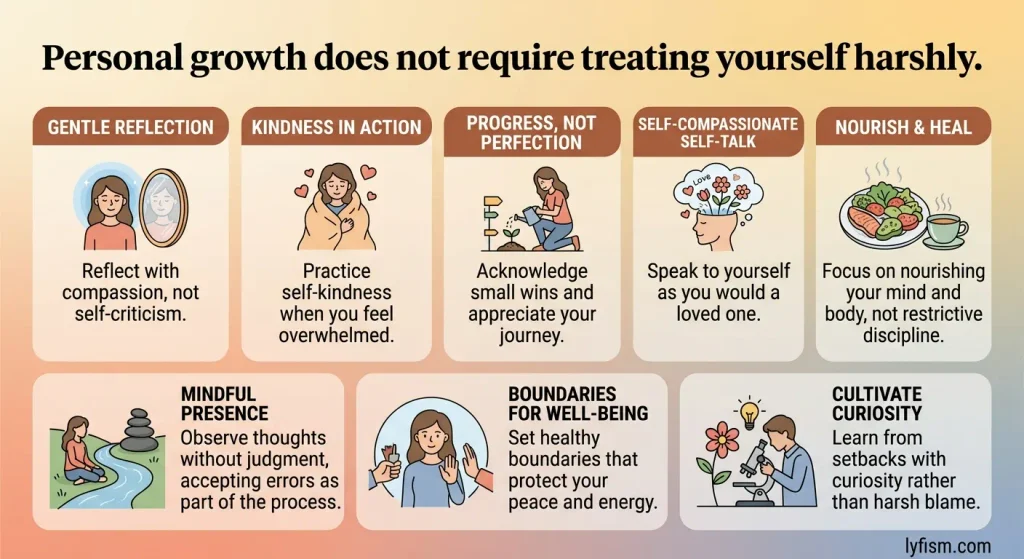
Personal growth does not require treating yourself harshly.
If you make a mistake, there is a difference between:
“I failed, so I’m useless.”
and:
“That didn’t work. What can I learn from it?”
The second response does not excuse the mistake. It makes learning easier.
Research has found a substantial association between self-compassion and well-being, based on a meta-analysis of 79 samples involving more than 16,000 participants. More recent research has also examined relationships between self-compassion, stress, and health-related behavior.
Self-compassion doesn’t mean avoiding responsibility.
A practical version sounds more like:
Be honest about the mistake, be fair about what it means, and decide what to do next.
Improve the Way You Handle Difficult Conversations
Personal growth eventually shows up in relationships.
You may learn to:
- Listen without immediately defending yourself
- Say no without unnecessary hostility
- Express disagreement respectfully
- Ask for clarification instead of assuming
- Apologize when appropriate
- State boundaries clearly
- Admit when you don’t know something
- Discuss problems before resentment builds
Consider a simple communication pattern:
Observation → Impact → Need → Request
For example:
“When plans change without telling me, I find it difficult to organize my time. I’d appreciate knowing earlier when possible. Could you let me know before changing the plan?”
That is more useful than silently building resentment or starting with an accusation.
Growth isn’t only about becoming better at managing yourself.
It also involves learning how to interact with other people more effectively.
Design Your Environment to Support the Person You Want to Become
Personal growth becomes easier when your environment supports your intentions.
Suppose you want to read more.
You could rely entirely on motivation.
Or you could:
- Keep a book beside your bed
- Remove distracting apps from your home screen
- Keep your reading device accessible
- Set a regular reading time
- Leave your phone in another room
The second approach reduces the number of decisions required.
Apply the same principle elsewhere.
Review Your Progress Without Turning Life Into a Scorecard
Tracking progress can be useful, but constant measurement can become another source of pressure.
Instead of asking:
“Am I becoming a completely different person?”
ask:
- What can I do now that was difficult before?
- Do I understand my patterns better?
- Am I recovering from mistakes more effectively?
- Have some old problems become easier to handle?
- Am I making decisions more deliberately?
- Have my habits become more consistent?
- Are my actions becoming more aligned with what matters to me?
Personal growth is often subtle.
You may not notice it day by day.
The change becomes clearer when you compare your current responses with your older patterns.
A Simple Personal Growth Framework
If you don’t know where to begin, use this five-step system:
1. Notice
Identify something that isn’t working.
Example: “I keep checking my phone whenever work becomes difficult.”
2. Understand
Ask why the pattern happens.
Example: “I may be using my phone to escape difficult or boring tasks.”
3. Choose
Select one behavior to change.
Example: “I’ll work for 20 minutes before checking my phone.”
4. Design
Make the behavior easier to perform.
Example: Put the phone in another room during the 20-minute work period.
5. Review
After a week, evaluate what happened.
Example: “Twenty minutes work in the morning, but not after long meetings. I’ll use a shorter work block in the afternoon.”
Then repeat.
This creates a cycle:
Notice → Understand → Choose → Design → Review
That is much more sustainable than constantly searching for a completely new self-improvement strategy.
Signs That You May Be Experiencing Personal Growth
Personal growth doesn’t always feel exciting.
Sometimes it looks like:
- Saying no without excessive guilt
- Asking for help sooner
- Changing your mind when new evidence appears
- Recovering faster from mistakes
- Listening more carefully
- Taking responsibility for your choices
- Setting clearer boundaries
- Choosing long-term priorities over immediate distractions
- Becoming less reactive
- Trying something unfamiliar
- Recognizing patterns you previously couldn’t see
- Treating yourself with more fairness
- Making decisions that better reflect your values
One useful way to think about growth is:
The situation may stay difficult while your response becomes more capable.
That distinction matters.
Personal growth does not mean creating a life without problems.
It means developing better ways to navigate the problems that inevitably appear.
Common Personal Growth Mistakes
Trying to change everything at once
Too many goals compete for attention.
Instead: Choose one meaningful behavior.
Consuming more advice than you apply
Another book, podcast, or video won’t automatically create change.
Instead: Turn one useful idea into an experiment.
Comparing your progress with other people
Someone else’s timeline tells you very little about what your own growth requires.
Instead: Compare your current behavior with your previous patterns.
Treating failure as evidence that you cannot change
Missing a few days doesn’t erase previous progress.
Instead: Examine what disrupted the behavior and adjust the system.
Confusing discomfort with growth
Not everything difficult is beneficial.
Instead: Ask whether the discomfort is helping you develop something that matters.
Making productivity the definition of growth
Being constantly busy isn’t the same as becoming wiser, healthier, more capable, or more aligned with your values.
Instead: Include relationships, character, learning, well-being, and meaningful choices in your definition of growth.
A 30-Day Personal Growth Experiment
You don’t need a complicated transformation program.
Try this simple four-week experiment.
Week 1: Awareness
Spend five minutes each evening answering:
- What went well today?
- What didn’t?
- Did I notice about myself?
- Should I handle differently tomorrow?
Week 2: One Behavior
Choose one behavior connected to your biggest observation.
For example:
“Before checking social media in the morning, I will complete my first important task.”
Week 3: Improve the Environment
Make that behavior easier.
Remove one obstacle and add one useful cue.
Week 4: Review
Ask:
- Changes occured?
- Did thePlan work?
- Didn’t?
- Has the behavior become modified?
- What should I continue?
Then decide whether the behavior deserves another month.
This approach keeps personal growth connected to everyday life rather than turning it into an endless self-improvement project.
Personal Growth Is Not About Becoming Perfect
There is a subtle problem with the phrase “be the best version of yourself.”
Taken too literally, it can make life feel like an unfinished project.
There is always another habit to fix.
A skill to learn.
Weaknesses to eliminate.
A productivity system to try.
That mindset can make even genuine progress feel inadequate.
A healthier approach is to ask:
“What would make my life more meaningful, manageable, capable, or aligned with my values?”
Sometimes the answer is learning.
Sometimes it is changing a habit.
Personal growth is not a race toward perfection. It is an ongoing process of becoming more aware and developing ways of living that fit the person you want to be.
Research on personal growth similarly describes it as gradual and dynamic rather than a simple linear sequence.
How to Start Personal Growth Today
Don’t create a 25-item improvement plan.
Do this instead:
1. Identify one recurring problem.
Choose something that genuinely affects your life.
2. Describe the behavior.
Make it observable.
3. Choose one small change.
Make it easy enough to repeat.
4. Create an if-then plan.
Decide beforehand what you will do in a specific situation.
5. Change your environment.
Remove friction from the behavior you want.
6. Review once a week.
Keep what works and modify what doesn’t.
7. Repeat.
Personal growth becomes meaningful when insight turns into behavior.
Conclusion
Personal growth is not about constantly fixing yourself.
It is about becoming more aware of how you think, behave, choose, communicate, and respond—and then deliberately develop the areas that matter.
Start small.
Choose one meaningful area.
Turn it into a specific behavior.
Build a system around it.
Review what happens.
Then adjust.
The most useful personal growth may not be the change other people notice. It may be the quiet difference between how you used to respond to life and how you respond now.
FAQs
What is personal growth?
Personal growth is the ongoing process of developing self-awareness, skills, habits, behaviors, perspectives, and ways of responding that support a more intentional and effective life. It can involve personal, social, emotional, intellectual, or practical development.
Why is personal growth important?
Personal growth can help you understand yourself better, develop useful capabilities, respond to challenges more deliberately, and align your everyday behavior with your priorities and values.
What are examples of personal growth?
Examples include improving communication, developing healthier routines, learning a new skill, becoming more aware of emotional patterns, setting boundaries, managing time better, taking responsibility for mistakes, and becoming more open to learning.
How do I start personal growth?
Start with one area that genuinely matters to you. Identify a specific behavior you want to change, create a small action around it, adjust your environment to support it, and review your progress regularly.
What is the difference between personal growth and self-improvement?
Self-improvement often focuses on developing a particular skill, behavior, or result. Personal growth is broader and can include changes in self-awareness, values, relationships, perspectives, and ways of responding to life.
Does personal growth happen quickly?
Usually, meaningful personal growth is gradual rather than an overnight transformation. Research describing personal growth as a process emphasizes that it can be dynamic, individualized, and unfold over longer periods.
Can personal growth improve relationships?
It can help when growth involves practical relationship skills such as listening, communicating clearly, taking responsibility, respecting boundaries, and responding less reactively. It does not guarantee that every relationship will improve, because relationships involve multiple people and circumstances.
Is self-compassion part of personal growth?
Self-compassion can be part of personal growth because it allows people to respond to mistakes and difficulties with greater understanding while still taking responsibility for their actions. Research has found a meaningful association between self-compassion and well-being.
How can I measure personal growth?
Look for changes in your behavior and responses rather than relying only on feelings. Ask whether you handle recurring situations differently, have developed useful skills, make decisions more deliberately, or understand your own patterns better.




Pingback: Studying the Mindset