

Most people search for relationship advice because something feels off. Conversations that used to flow now turn tense. Small habits start to annoy me. You wonder whether the distance is normal or a warning sign. Or you simply want to stop repeating the same arguments.
Good relationship advice is not a list of romantic gestures or “never go to bed angry” slogans. It is practical guidance on how two people can stay connected while remaining individuals—how they talk, repair after friction, protect emotional safety, and keep choosing each other in ordinary moments.
This article focuses on what consistently helps: clearer communication, better conflict habits, realistic expectations, and small daily actions that compound over time. It draws on well-established patterns from relationship research and clinical observation without promising instant transformation.
What Effective Relationship Advice Actually Does
Helpful advice does three things. It names the real problem instead of blaming one person. It gives language and steps you can try the same day. And it stays honest about limits—some patterns need professional support, and some relationships are not sustainable even with good tools.
The most useful guidance treats a relationship as a living system. Both people contribute to the climate. One person’s stress, childhood patterns, or communication style affects the other. Change often starts with one person adjusting their own responses, which then invites a different response from the partner.
Communication That Builds Connection Instead of Distance
Poor communication is rarely about “not talking enough.” It is usually about how people talk when they feel threatened, tired, or unseen.
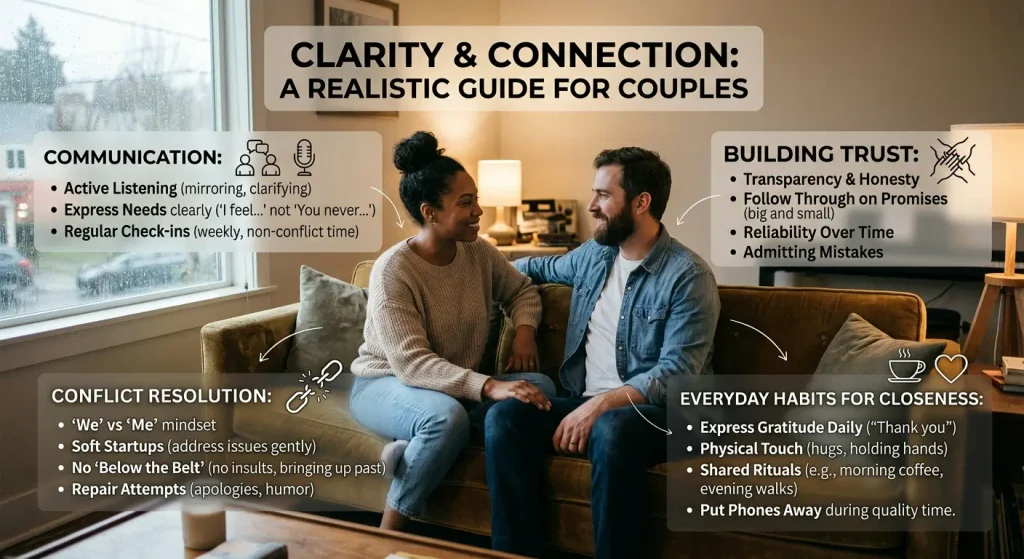
Use “I” language that describes impact
Instead of “You never listen,” try “When I share something and the conversation shifts quickly, I feel dismissed.” This keeps the focus on your experience rather than a character attack. Your partner is more likely to stay open.
Soften the start of hard conversations
How a difficult topic begins often determines whether it becomes productive or defensive. A brief heads-up helps: “There’s something on my mind I’d like to talk about when you have a few minutes—are you free later today?” This reduces the sense of ambush.
Listen to understand, not to reload
Active listening means setting aside your rebuttal long enough to reflect back what you heard: “It sounds like you felt alone with the decision and wished I’d checked in.” You do not have to agree with every detail. Feeling understood often matters more than winning the point.
Ask better everyday questions
“How was your day?” often gets a one-word answer. Try “What was the most interesting part of your day?” or “Is there anything still sitting with you from earlier?” Curiosity signals ongoing interest in the other person’s inner world.
Handling Conflict Without Eroding the Relationship
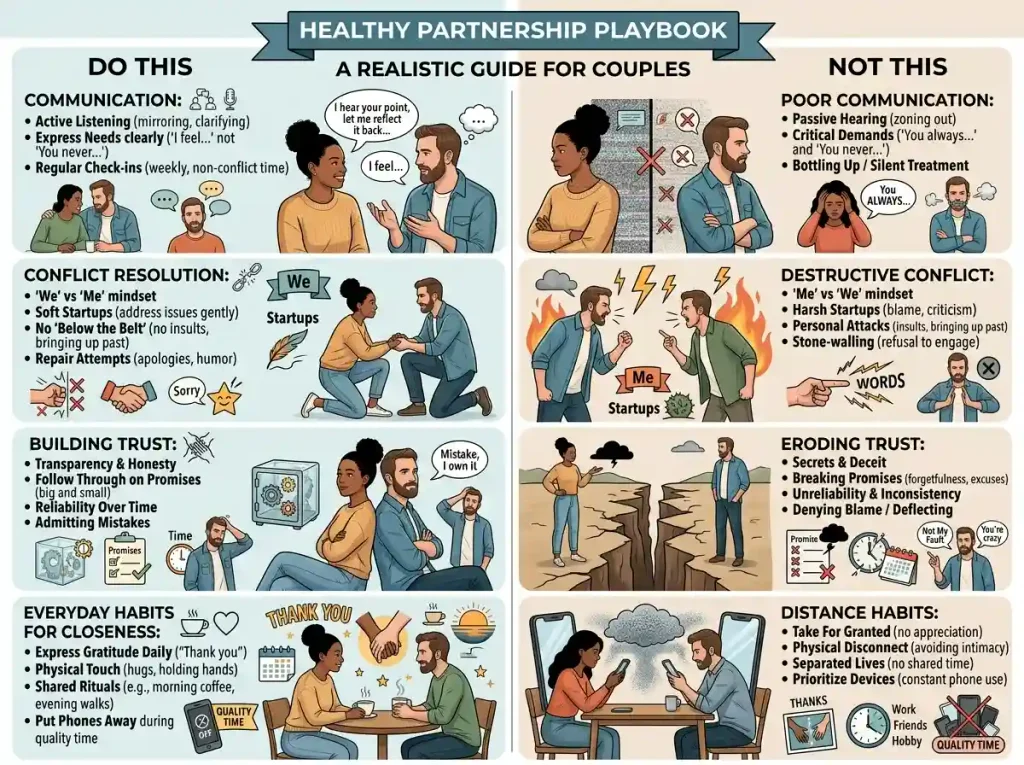
Conflict itself is not the enemy. Contempt, criticism, defensiveness, and stonewalling (patterns long studied in relationship research) are. The goal is not to eliminate disagreement but to keep respect and repair possible.
Take a pause before escalation
When emotions run high, physiology takes over. Agree in advance that either person can call a short break—20 to 30 minutes—to calm down, with a clear plan to return to the conversation. Use the break to regulate, not to rehearse the argument.
Focus on the specific behavior and the need underneath
“You always leave dishes in the sink” quickly becomes global. “When the sink is full after I’ve already cleaned the kitchen, I feel like the mental load is uneven. Can we figure out a system that feels fairer?” moves the conversation toward solutions.
Make repair attempts early and often
A simple “That came out harsher than I meant—can I try again?” or a light touch on the arm can stop a spiral. Accepting a repair attempt (even if imperfect) is as important as offering one.
Close the loop after an argument
Once both people are calmer, a brief closing conversation helps: What was the impact on each of you? What would you like to try differently next time? This turns conflict into information instead of leftover resentment.
Building and Protecting Emotional Safety
Emotional safety is the sense that you can be imperfect, express needs, and still remain valued. Without it, people protect themselves with distance, sarcasm, or control.
Trust grows through consistent small actions: following through on what you say, being transparent about plans and feelings, and responding to bids for connection. A bid can be as small as a shared glance, a comment about the weather, or a request for a hug. Turning toward these moments—rather than ignoring or dismissing them—builds connection over time.
Assume good intent when possible. A forgotten text is more often a distraction or stress than deliberate neglect. Checking the assumption (“Were you overloaded today?”) usually works better than accusing.
Everyday Habits That Strengthen the Bond
Grand gestures matter less than repeated ordinary ones.
- Create micro-rituals of connection. Five minutes of undistracted talk in the morning or evening, a shared walk, or a consistent good-morning message.
- Keep updating your “map” of each other. People’s stresses, hopes, and preferences change. Ask about current pressures, small wins, or what currently feels supportive.
- Express specific appreciation. “I noticed you handled the school email this morning—thank you” is more powerful than a generic “You’re great.”
- Protect time that is not about logistics. Schedule conversations that are not about kids, money, or chores so you keep knowing each other as people.
- Maintain individual lives and outside support. No single partner can meet every emotional need. Friendships, hobbies, and personal growth reduce pressure on the relationship.
Realistic Expectations and Personal Responsibility
Many relationship struggles come from unspoken or unrealistic expectations—that a partner should know what you need without being told, that love should feel effortless, or that one person will never change while the other is expected to.
Lowering perfectionistic standards does not mean accepting disrespect. It means accepting that both people will sometimes be tired, imperfect, and human. Each partner taking ownership of their own contribution (“I got defensive and shut down”) is usually more effective than waiting for the other person to change first.
Compatibility involves shared values and the ability to solve problems as a team. Chemistry alone is rarely enough over the long term.
Common Mistakes That Quietly Damage Relationships
- Using the relationship as the only source of emotional regulation
- Keeping score of who does more
- Avoiding hard topics until resentment builds
- Criticizing character instead of describing impact
- Expecting mind-reading
- Neglecting repair after conflict
- Treating boundaries as punishments rather than clarity about what you can and cannot accept
Healthy boundaries sound like: “I want to continue this conversation, but I will step away if the volume stays this high.” They are statements about your own limits, not attempts to control the other person.
When Relationship Advice Is Not Enough
Self-help tools have limits. Consider professional support if:
- The same painful patterns repeat despite sincere effort
- There is ongoing contempt, emotional or physical safety issues, or betrayal that has not been repaired
- One or both people feel chronically anxious, depressed, or diminished in the relationship
- Communication has collapsed into silence or constant fighting
A skilled couples therapist or counselor can help map the cycle you are stuck in and teach different moves. Individual therapy is also valuable when personal history or mental health is heavily shaping the relationship.
Seeking help is not a failure. It is a practical step when the tools available at home are no longer enough.
Putting the Advice Into Practice
Start small. Choose one communication habit this week—soft startups, more specific appreciation, or a five-minute check-in. Notice the effect. Then add another. Sustainable change is usually incremental.
Healthy relationships are not free of friction. They are relationships in which both people keep practicing the skills of connection, repair, and mutual respect. The advice that lasts is the kind that helps you do that, day after ordinary day.
Frequently Asked Questions
What is the most important relationship advice?
The most consistently useful advice centers on communication and emotional safety: speak about impact rather than attacking character, listen to understand, respond to small bids for connection, and repair after conflict. These habits create the conditions in which other positive changes can stick.
How do you improve communication in a relationship?
Use “I” statements, soften the beginning of hard conversations, practice reflecting what you heard before responding, and schedule brief check-ins that are not about logistics. Reduce multitasking during important talks so both people feel attended to.
How often should couples argue?
There is no ideal frequency. What matters more is how conflict is handled. Occasional disagreement is normal. Patterns of contempt, criticism without repair, or chronic stonewalling are more concerning than the number of arguments.
When should you seek professional relationship help?
Consider it when the same destructive cycle keeps repeating, trust has been significantly damaged, one or both partners feel unsafe or chronically unhappy, or efforts to change have not produced lasting improvement. Early support often works better than waiting until the relationship feels beyond repair.
Can one person improve a relationship alone?
One person changing their responses (listening differently, offering softer startups, taking responsibility for their part) can shift the dynamic and invite a different response. Lasting improvement, however, usually requires both people to engage. If the other person consistently refuses any change or accountability, that itself is important information.




Pingback: Personal Growth | Practical Ways to Grow as a Person
Pingback: Small Ways to Improve Yourself Every Day
Pingback: Studying the Mindset
Pingback: What Is a Happy Lifestyle? Simple Ways to Build a Happier Life
Pingback: Traits of a Successful Person
Pingback: How to Set Boundaries Without Feeling Guilty: 10 Scripts That Help
Pingback: How to Be Happy Alone: Enjoying Solitude Without Loneliness
Pingback: How to Communicate Better in a Relationship: 12 Daily Habits
Pingback: Small Things That Make Life Easier: 15 Tiny Habits
Pingback: How to Make New Friends as an Adult: 15 Realistic Ways