

Always Losing Your Keys, Wallet or Phone? 10 Fixes That Work
Late for work, bag half-zipped, patting every pocket in a rising panic — keys? Gone. Wallet? Nowhere. Phone? Probably on silent, somewhere in the house. Here’s the good news: learning how to stop losing your keys, wallet and phone has almost nothing to do with having a better memory. It’s about building a system so simple that your memory barely has to work at all.
Losing things isn’t a character flaw. It’s what happens when busy brains run on autopilot. The ten fixes below remove the need for willpower and recall — they make “not losing things” the automatic outcome of how your home and habits are set up. These are the kind of simple life hacks for everyday problems that quietly save you hours every month.
Why You Keep Losing Things (It’s Not Forgetfulness)
Here’s the reassuring truth: your memory isn’t broken. When you set your keys down while thinking about dinner and answering a message, your brain never properly records where they went. The fix isn’t to “try harder to remember” — it’s to remove remembering from the equation entirely. Every fix below replaces memory with design, so your things end up in the right place whether you were paying attention or not.
How to Stop Losing Your Keys, Wallet and Phone: 10 Fixes That Work
Start with fixes 1–3 — they solve most of the problem on their own. Add the rest over the next week or two.
1. Give Every Essential One Home
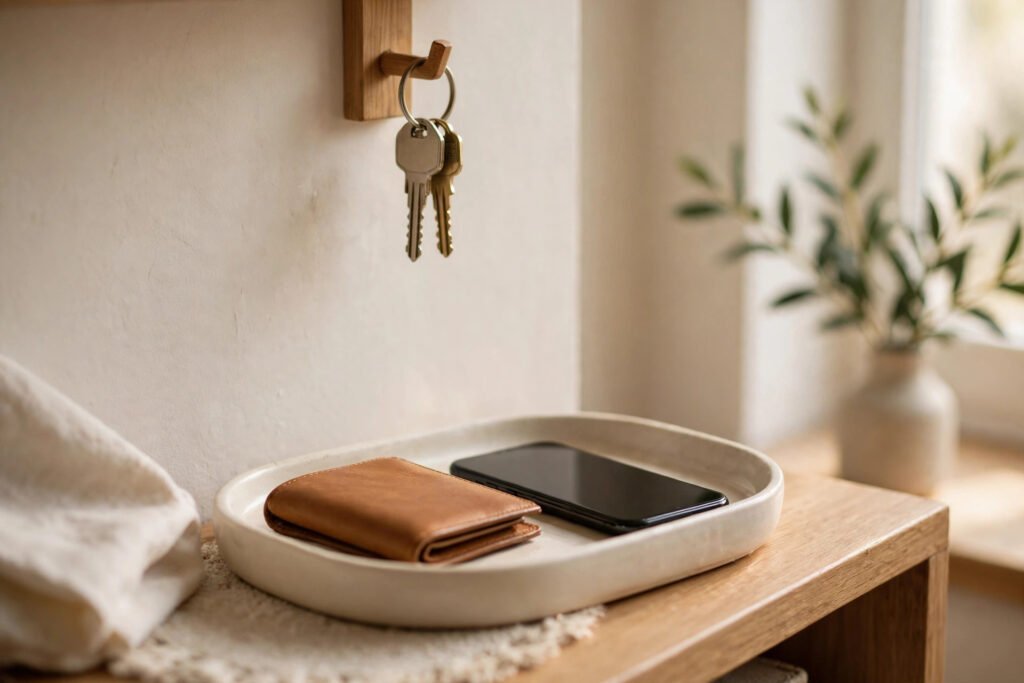
Everything you carry daily needs exactly one home — not “usually the counter,” but one specific spot. Keys on the hook by the door. Wallet in the tray. Phone on the nightstand. When every item has a single address, putting it away takes two seconds and finding it takes one.
Life lesson: Decisions you make once beat decisions you remake daily. A home for everything means your tired evening self doesn’t have to think — the system thinks for you.
2. Create a Launch Pad by the Door
A launch pad is a small station — a tray, a shelf, a basket — right where you enter and leave. Keys, wallet, phone, sunglasses, and tomorrow’s essentials all live there. When you walk in, you unload. When you walk out, you load up. Nothing travels deeper into the house to get lost. It pairs perfectly with drop zones in every room if you want to extend the idea.
Life lesson: Clutter isn’t a personality trait; it’s what happens when things have no landing spot. Give them one, and order follows on its own.
3. Do the Pat-Down Before You Leave
Before you step out the door, run the classic three-point check: phone, wallet, keys. Pat each pocket (or glance at the launch pad). It takes five seconds and catches 90% of “I left it behind” disasters before they start.
Make it a ritual, not a chore — tie it to an existing habit, like locking the door. Door locked means the pat-down already happened. Within two weeks it becomes as automatic as checking the mirror.
Life lesson: The cheapest insurance is a five-second habit. Tiny checks prevent the big, expensive scrambles.
4. Attach a Tracker and Stop Searching
Bluetooth trackers (Tile, AirTag, and similar) are the closest thing to a memory upgrade you can buy. Attach one to your keys and slip one in your wallet, and “where are my keys?” becomes a phone notification instead of a twenty-minute hunt. Most can also ring your phone from the tracker — solving the on-silent, under-the-couch problem.
Life lesson: Smart tools don’t replace good habits — they catch you on the days good habits slip. There’s no prize for doing everything the hard way.
5. Downsize What You Carry
Audit what you carry: do you need twelve cards in your wallet, or three? Two keychains of mystery keys, or one ring with the daily essentials? A slim wallet and a single key ring are dramatically harder to misplace — and much easier to spot. This is one of those simple ways to make life easier that ripples into everything: less to carry, less to lose, less to worry about.
Life lesson: Owning less to track means less that can go missing. Simplification is a security system too.
6. Run a Two-Minute Nightly Reset
Every evening, spend two minutes returning the big three to their homes: phone to the charger, keys to the hook, wallet to the tray. Two minutes tonight buys you a panic-free morning. Tie it to something you already do, like setting your alarm, and it becomes part of the evening’s closing sequence.
Life lesson: Mornings are won the night before. Two quiet minutes of order tonight is a gift to tomorrow’s rushed self.
7. Make Your Things Impossible to Miss
A black wallet on a dark bag interior is camouflage. Fix it: bright keychain, colorful phone case, a wallet in a color you’d notice from across the room. Distinctive items are found faster and stand out against every surface. The items people lose most are the ones that blend in — so stop letting yours blend in.
Life lesson: Don’t fight your brain’s limits — design around them. Making things visible is easier than making yourself more observant.
8. Retrace Your Steps the Smart Way
When something does go missing, don’t wander the house opening random drawers. Stop and reconstruct: where did you last definitely have it? Walk that exact path mentally, then physically. Check the places it should be first (its home, the launch pad), then the three most likely deviations — the jacket you wore yesterday, the bag you switched to, the car seat.
This works because misplaced items are almost always within a short chain of your normal routine. And here’s the social side of it: most households have an unspoken rule about who “loses things,” and that label sticks unfairly. A calm, systematic search beats the frantic blame game every time.
Life lesson: Panic scatters; method finds. A calm retrace solves in minutes what frantic searching can’t solve in an hour.
9. Build a Leaving-the-House Ritual
String your exit habits into one short sequence: shoes on, pat-down, grab the bag from the launch pad, lock the door. Same order, every time. Rituals work because they turn a checklist into muscle memory — you stop relying on remembering and start relying on rhythm.
If mornings are chaotic, post the sequence on the inside of your door for the first month. Nobody will judge you for it; they’ll probably copy it. These are exactly the kind of clever solutions for everyday problems that spread through households once one person tries them.
Life lesson: Routines are just good decisions you’ve pre-made. Pre-make this one and your future self walks out calm every morning.
10. Get the Whole Household on Board
A system only one person follows is a system that keeps failing. If you share your home, agree on the launch pad together: everyone’s keys on the hooks, everyone’s essentials in the trays. When the whole household uses the same system, items stop migrating to mystery locations. Frame it as a shared win — “let’s stop losing our mornings to searching.”
Life lesson: Good systems are contagious. One person’s launch pad becomes the household’s launch pad, and everyone’s mornings get easier.
A Sociologist’s Take: Why Modern Life Makes Us Lose Things
Here’s a thought that might surprise you: people lose small essentials more today than they did fifty years ago — and it’s not because we’re more careless. It’s because modern life asks our brains to track far more than they were built for: more items, more tasks, more background noise.
Everyday forgetfulness often mirrors the structure of our lives, not the quality of our minds. When your day is fragmented into dozens of micro-tasks, attention gets sliced thin — and thin attention drops things. The keys on the wrong counter aren’t a personal failing; they’re a symptom of an overloaded life.
That’s why systems beat willpower here. A launch pad, a pat-down, a nightly reset — these are small pieces of infrastructure for your home. They quietly absorb the chaos, so your brain doesn’t have to. You’re not fixing yourself; you’re fixing the setup. And that’s a much kinder project.
FAQs on How to Stop Losing Your Keys, Wallet and Phone
Why do I always lose my keys and phone even though I try to remember?
Because “trying to remember” targets the wrong stage. Items get lost when they’re set down without attention, so there’s nothing stored to recall later. The fix is design, not effort: give everything one home and a launch pad.
Do Bluetooth trackers really help with lost items?
Yes — they’re one of the highest-impact fixes on this list. A tracker on your keys and one in your wallet turns most searches into a quick phone ping. They’re affordable, the batteries last about a year, and they catch exactly the chaotic-day failures that good habits miss.
How can I stop losing my wallet when traveling?
Travel breaks every home routine, so build a travel version: one specific pocket or pouch that holds your wallet at all times, and a pat-down every time you stand up. Never set it on a counter “just for a second” — that’s where travel losses happen.
What’s the single best habit to stop losing things for good?
The launch pad by the door. One spot where the essentials live, loaded on entry and unloaded on exit. It solves the majority of cases by itself, and every other fix on this list works better once the launch pad exists.
I live with people who never put things back. What then?
Start with your own system and let the results speak — calm, on-time mornings are persuasive. Then propose one shared change (the launch pad) framed as a household win, not a complaint. Most resistance melts once people feel the difference for a week.
Final Thoughts
Losing your keys, wallet, or phone isn’t a sign of a scattered mind — it’s a sign of a system that was never built. The fixes above don’t ask you to become a different person; they ask you to set up your home so that the person you already are can’t go wrong.
Pick the launch pad first. Do it today. Tomorrow morning, you’ll feel the difference before you’ve even had your tea.

Asad Ullah Ijaz is a sociologist who writes about modern life — how society, culture and everyday norms shape the way we think, work and live.