

You are already late. Your bag is packed, your shoes are on — and your keys have vanished. You check the counter, the sofa, your jacket pockets, the counter again. Five minutes later they turn up in yesterday’s trousers. Sound familiar?
The keys were never “lost” — they had no home. Learning how to create drop zones at home, small deliberate spots where everyday items always land, is one of the simplest upgrades you can make. No renovation, no big spending.
1. What Exactly Is a Drop Zone?
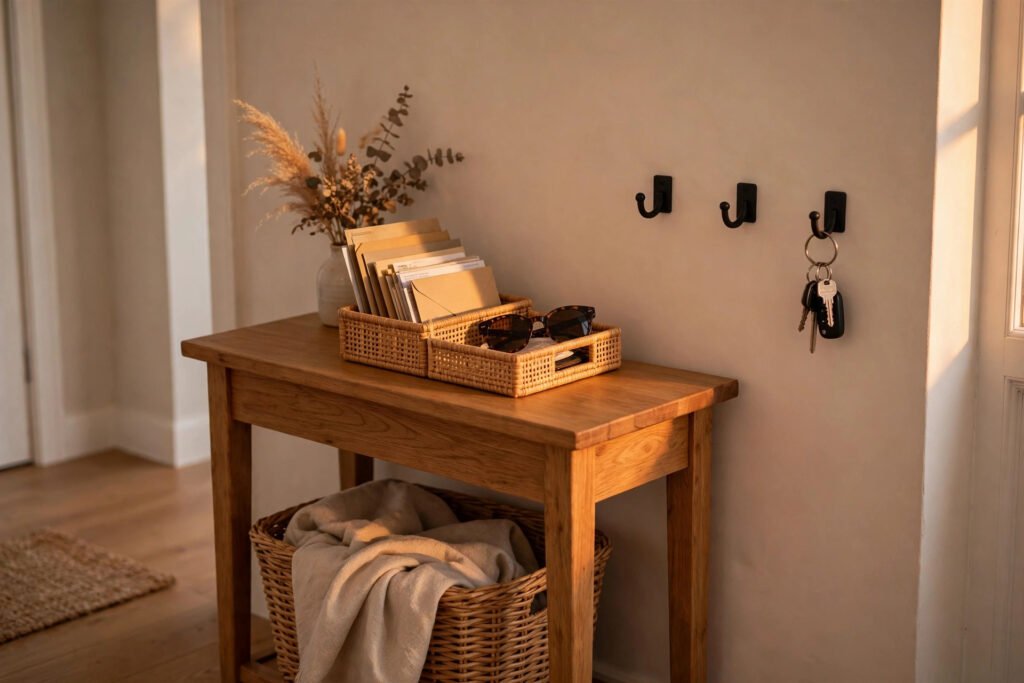
A drop zone is a designated spot near where you use something — a place where a specific item always lands. Keys on a hook by the door, mail in a tray on the counter, your bag in a basket by the sofa: a landing pad for the things that otherwise drift.
Most homes already have accidental drop zones — the sofa arm that collects the remote, the counter that swallows every letter. The difference is intention: without one, today’s mail becomes this week’s pile becomes the counter you can’t use. It is not about being tidy. It is about being predictable.
2. Why “One Home for Every Thing” Works
Every time you toss your keys “somewhere,” you create a future search mission. Multiply that by wallet, sunglasses, mail, and chargers, and you’ve added ten tiny stress events to every week.
Give each item one home and two things change: putting it away becomes automatic within a week, and finding it takes zero effort. The key hunt disappears, along with the argument about who moved the charger.
This is the same philosophy behind our daily life hacks: small fixes that make the whole day run smoother. Start with one zone and let the habit prove itself.
Life lesson: Willpower is unreliable; placement is not. You don’t need more discipline — you need fewer decisions. Give everything one home and let the system do the remembering.
3. How to Create Drop Zones at Home: Start With the Entryway
The entryway gives the biggest payoff — it is where you arrive loaded down and where you leave in a hurry:
- Hooks on the wall for keys — one per person, at everyone’s reach height. Kids get lower hooks.
- A small tray on a shelf for wallets, sunglasses, and earbuds.
- A basket for the bag or backpack that goes out with you daily.
- A lidded box for incoming mail, so it doesn’t migrate across the house.
Keep it within arm’s reach of the door and empty it lightly each evening. An overflowing zone becomes just another clutter spot.
If the whole home feels like more than one zone can fix, read how to simplify your life when overwhelmed — overwhelmed homes need lighter systems, not stricter ones.
4. Taming the Kitchen Counter: The Mail Command Center
The kitchen counter is the Bermuda Triangle of the home — mail, receipts, school forms, and loose change all vanish into it. Give the drifters a contained home.
A slim vertical mail sorter costs very little and changes everything. Divide it into three sections: incoming (this week’s items), action (bills to pay, forms to fill), and filing (things worth keeping). Once a week, spend ten minutes processing the first two.
Add a small tray beside it for spare keys, loyalty cards, and batteries — and send junk mail straight to recycling on arrival. That single habit cuts counter clutter in half.
5. Bedroom Drop Zones for Easier Mornings
Mornings go wrong in the bedroom first — the missing shoe, the half-packed bag, before your brain wakes up:
- A nightstand tray for phone, charger, glasses, water, and medication.
- A “launch pad” corner for tomorrow’s outfit — shoes underneath, bag on top, coat over the back.
- A small hamper for the in-between clothes — not dirty, not fresh — that usually end up on “the chair.”
The launch pad pairs well with evening planning — our guide on how to plan your day the night before covers the routine side, the drop zone the physical side. Chaotic mornings become genuinely rare.
Life lesson: A calm morning is designed the night before, not wished for at the alarm. Tonight’s setup is a gift to tomorrow’s you — be kind to that person.
6. The Home Office Drop Zone
A home desk collects the same drift as the kitchen counter — papers, chargers, notebooks, the headset — except it sits in your eyeline all day, taxing your focus.
Put a small “inbox” tray at the corner of the desk for loose papers. Then add one charging dock — a single spot for laptop, phone, and headset. Cable clutter makes a desk feel chaotic even when it is organized; one dock fixes most of it.
End the workday with a two-minute reset: papers into the inbox, mugs to the kitchen, laptop closed.
Life lesson: A social-norms truth: nobody awards prizes for the tidiest desk, and “perfect home office” photos online are staged. Your workspace only needs to serve one person — you, on a tired Thursday. Build for your real life, not anyone else’s feed.
7. The Laundry and Utility Zones Everyone Forgets
Laundry hinges on two invisible drop zones: where dirty clothes land, and where clean clothes wait. When either is missing, clothes live on floors, beds, and that infamous chair.
Put one hamper where clothes actually come off — near the bedroom or bathroom. Then keep a basket near the dryer for clean laundry waiting to be folded, so “I’ll fold them in a minute” stays a bounded state, not a permanent mountain.
One more: a small cleaning caddy — spray, cloths, a sponge — under the sink. When cleaning supplies have one home, tidying becomes grab-and-go, which means it actually happens.
8. How to Create Drop Zones at Home When You Share the Space
With roommates, a partner, or kids, a drop zone only works if everyone uses it — and shared spaces need them most, since most clutter arguments are really “where does this go?” arguments in disguise.
- Design it together. If your roommate never uses the key hook, it is in the wrong place for them. Ten minutes deciding together beats a month of nagging.
- Label the zones at first. A small “Keys” or “Mail” label removes all ambiguity — remove them once the habit sticks.
- Respect other people’s zones. Dumping your stuff in someone else’s spot kills a shared system fast.
With kids, make it a game for the first week — who gets everything home before dinner? For bigger-picture harmony, how to organize your everyday tasks extends the same “everything has a place” thinking to your time and to-dos.
9. Keep It Working With a Five-Minute Weekly Reset
Drop zones are set-and-gently-maintained, not set-and-forget. The mail tray fills up, the key bowl collects mystery items, the launch pad accumulates “temporary” things. That is normal — zones fail when nobody tends them.
Once a week, spend five minutes per zone: return strays to their homes, recycle the expired, toss the broken. Tie it to something you already do — Sunday evening, the trash run.
And if a zone stops working, blame the design, not yourself. Move it closer, lower it, simplify it — the best system survives your laziest day.
A Sociologist’s Take: Why the Mess on Your Counter Feels Like a Moral Failing
Here is something worth noticing: clutter rarely feels like just clutter. It feels like a verdict. The pile of mail on the counter, the shoes scattered by the door — somehow they whisper that you are lazy, disorganized, not quite an adult. That feeling is not natural. It is learned.
The “perfect home” is on display everywhere — staged photos and house tours presented as normal. So “guests are coming over” becomes a panic, not a pleasure, because an untidy home is quietly read as a character flaw. Nobody voted for that rule, yet most of us feel it.
Here is the reframe: a messy counter is not evidence of a messy character. It is evidence of a full life. Work, kids, side projects, friendships — the things filling your home are often signs of things that matter. The cultural script says a tidy home equals a good person, but that script was written by advertisers, not by anyone who knows your Tuesdays.
So build your drop zones for the right reason: not to impress visitors or match a photo, but to make your own days easier. An organized home is a kindness you do for yourself, not a performance for everyone else.
Frequently Asked Questions
What is a drop zone at home?
A drop zone is a designated spot where a specific everyday item always goes — a hook for keys by the door, a tray for mail on the counter. It is the opposite of “I’ll just put this down here for now.”
How many drop zones should a house have?
Start with one — the entryway — and add more only where clutter keeps recurring. Most homes end up with four to six. A zone you never use is just another shelf.
What should I put in a drop zone?
Only items you use daily: keys, wallet, phone, bag, mail, sunglasses, chargers, school papers. If something sits untouched for a week, it belongs elsewhere — move it and free the spot.
Do drop zones work in small apartments?
They work even better in small apartments, because small spaces punish drift faster. One wall hook, one small tray, and one basket can be a complete system — every daily item gets exactly one home, within arm’s reach.
How do I get my family to actually use the drop zone?
Involve them in setting it up so the zones reflect their habits, not just yours. Label everything at first, and make each zone effortless — a hook at a child’s height gets used; one they can’t reach doesn’t.
Final Thoughts
You do not need a bigger home, a stricter routine, or more self-discipline — just keys where they always are, mail off the counter, and mornings without a search party.
That is what a drop zone gives you: predictability in the small moments that eat your days. Start with the entryway tonight — one hook, one tray, one basket. Twenty minutes, and tomorrow morning already feels different.
Because learning how to create drop zones at home is not about a picture-perfect house. It is about a house that cooperates with your life instead of complicating it — one small zone at a time.

Asad Ullah Ijaz is a sociologist who writes about modern life — how society, culture and everyday norms shape the way we think, work and live.



Pingback: The 10-Minute Daily Tidy-Up: A Room-by-Room Reset Routine