
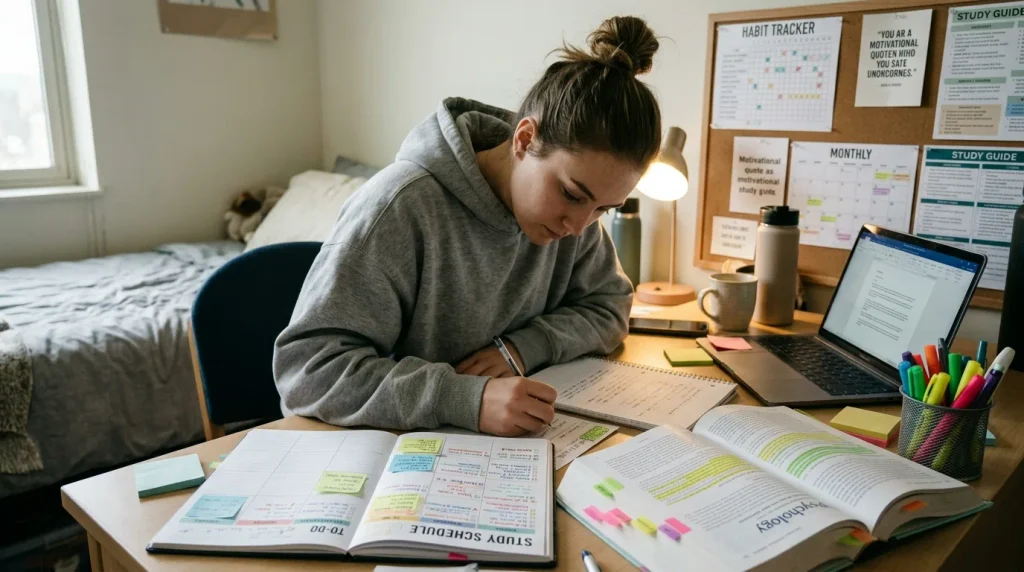

Studying for hours does not always lead to better results. You might reread the same chapter several times, highlight entire pages, or sit at a desk all evening and still struggle to remember the material during a test. The problem is not necessarily a lack of ability. Sometimes, the method simply needs to change.
The best ideas to improve study habits focus on how you learn, not just how long you sit with your books. A realistic study routine combines clear goals, active recall, spaced practice, fewer distractions, and enough rest to help your brain work effectively.
Whether you are in school, college, university, or preparing for a competitive exam, small changes can make studying more manageable. You do not need to adopt every technique at once. Begin with one or two methods, test what works for you, and build a routine you can maintain.
Why Good Study Habits Matter
Study habits are the repeated behaviors and strategies you use to learn, practice, and review information. Strong habits reduce the need to decide what to do each time you sit down to study. They also make it easier to notice gaps in understanding before an exam.
Good habits cannot guarantee a particular grade, but they can help you use your time more effectively. They are especially useful when you have several subjects, a busy schedule, or a large amount of material to cover.
1. Set a Specific Goal for Every Study Session
Avoid starting with a vague plan such as “study biology.” That instruction is too broad to guide your attention.
Choose a concrete outcome instead: review the process of photosynthesis, solve ten algebra problems, summarize one history section, or test yourself on 20 vocabulary words. A specific goal gives the session a clear finish line.
Before you begin, write down what you want to understand or complete. At the end, check whether you achieved it. If the task was too large, break it into smaller steps for the next session.
2. Use Active Recall Instead of Only Rereading
Rereading can make information feel familiar, but familiarity is not always the same as being able to remember it independently. Active recall means trying to retrieve information from memory before looking at the answer.
After reading a section, close the book and explain the main idea in your own words. Use flashcards, answer practice questions, or write down everything you remember about a topic. Then check your notes and correct any gaps.
This method may feel harder than rereading, but that effort can help reveal what you truly know and what needs more practice.
3. Space Out Your Study Sessions
Cramming the night before an exam may help you recall some material in the short term, but it is not a dependable strategy for long-term learning.
Spaced practice means reviewing information across multiple sessions rather than trying to learn everything at once. For example, you might review a topic on the day you learn it, revisit it two days later, and test yourself again the following week.
Adjust the schedule to the difficulty of the subject and the date of your exam. Topics you find challenging may need more frequent review. The key is to return to information before it has completely faded from memory.
4. Break Large Tasks Into Smaller Steps
A large assignment can feel intimidating when you look at it as one enormous task. Breaking it down makes it easier to begin and helps you see progress.
If you need to prepare for a science exam, your steps might be to list the topics, review one chapter, create practice questions, solve problems, and complete a timed quiz. Each step is specific enough to act on.
Small steps are particularly helpful when you feel overwhelmed or tend to procrastinate. You do not need to finish the entire assignment to make a useful start.
5. Create a Study Schedule You Can Actually Follow
A schedule should fit your real life, not an idealized version of it. Consider school or work hours, travel, meals, family responsibilities, and sleep before assigning study blocks.
Choose regular times when you can usually concentrate. If you have 45 minutes after school, use that period for one focused task rather than planning an unrealistic three-hour session that rarely happens.
Leave some flexibility for unexpected events. A schedule that can recover from a missed session is more useful than one that makes you feel you have failed after a single disruption.
6. Study in Focused Time Blocks
Long study sessions can become less effective when your attention repeatedly drifts. Try working in focused blocks followed by short breaks.
One option is 25 minutes of focused study followed by a five-minute break. If you prefer longer periods, try 40–50 minutes of work and then take a brief pause. Experiment to discover a rhythm that suits the task and your concentration.
During each block, choose one subject or activity. Switching between unrelated tasks can make it harder to maintain momentum.
7. Remove Distractions Before You Begin
It is much easier to concentrate when you do not have to resist distractions every few minutes.
Put your phone out of reach, silence nonessential notifications, close unrelated browser tabs, and keep the materials you need nearby. If noise is a problem, choose a quieter location or use comfortable hearing protection when appropriate.
You do not need a perfect study room. A tidy corner of a table can work if you make it easier to focus there than to scroll through your phone.
8. Make Your Notes Useful, Not Just Attractive
Beautiful notes can be satisfying to create, but decorating pages should not replace learning the content.
Organize notes around main ideas, definitions, examples, and questions. Use headings, diagrams, comparison tables, or brief summaries when they help you understand the material.
After class, try rewriting the central ideas from memory before checking your notes. This helps you identify which parts are clear and which need another look.
9. Practice With Questions and Real Problems
Understanding an explanation is only one part of learning. You also need to apply the knowledge.
Work through practice problems, past papers, sample questions, or exercises similar to those you expect in an assessment. When you get an answer wrong, study the reasoning behind the correct solution instead of simply memorizing it.
Keep a list of mistakes you repeat. Perhaps you rush calculations, overlook key words in questions, or confuse two concepts. Reviewing these patterns helps you decide where to spend your next study session.
10. Explain the Topic in Simple Language
Teaching a concept to someone else can reveal whether you understand it clearly. You can use this approach even when nobody is available to listen.
Pretend you are explaining the topic to a younger student. Define unfamiliar terms, describe the process in order, and give a simple example. Whenever you cannot explain a step, return to your materials and investigate the gap.
The aim is not to make every topic sound easy. It is to identify where your understanding is incomplete and strengthen it.
11. Look After Sleep, Food, and Movement
Effective studying depends on more than study techniques. Sleep supports memory and attention, while regular movement and adequate nourishment help you maintain energy.
Avoid treating an all-nighter as proof of dedication. Losing sleep can make concentration and recall more difficult, which may undermine the extra time you spent studying.
Try to maintain a consistent sleep schedule, eat regular balanced meals, drink water, and take movement breaks. These basics are not shortcuts, but they support the work you are doing.
12. Ask for Help Before You Fall Too Far Behind
Confusion often grows when you keep moving through new material without resolving earlier gaps.
If a concept remains unclear, ask your teacher, instructor, classmate, tutor, or another reliable source for an explanation. Bring a specific question, such as “Why does this step work?” rather than saying only that the whole chapter is confusing.
Seeking help is a learning strategy, not a sign that you lack ability. The sooner you address a gap, the less likely it is to affect later topics that depend on it.
13. Track Your Progress and Adjust
A study plan should change when the evidence shows that something is not working.
At the end of the week, review which topics you can answer confidently, where you still make mistakes, and which methods helped you remember information. Use quiz results and practice questions as evidence rather than relying only on how familiar the material feels.
If you are spending a lot of time rewriting notes but struggling to answer questions, shift more of your time toward active recall and practice. Let your results guide your next steps.
A Simple Study Routine to Get Started
Here is a practical 60-minute session you can adapt to your subject:
- 5 minutes: Choose one clear goal and gather materials.
- 20 minutes: Learn or review a small section of the topic.
- 10 minutes: Close the book and recall the main ideas from memory.
- 15 minutes: Answer practice questions or solve problems.
- 5 minutes: Check mistakes and note what needs another review.
- 5 minutes: Plan the next session and take a break.
For longer sessions, repeat the cycle with a suitable break between blocks. On especially busy days, a shorter session is still useful if it has a clear purpose.
Common Study Mistakes to Avoid
Some habits feel productive but may not help you learn as much as you expect. Watch for these patterns:
- Studying with your phone beside you and checking it repeatedly.
- Highlighting large sections without testing your understanding.
- Cramming all topics into one late-night session.
- Copying notes word for word instead of processing the ideas.
- Avoiding difficult subjects because they feel uncomfortable.
- Making a schedule so ambitious that it is impossible to maintain.
- Ignoring mistakes instead of learning why they happened.
Replace one unhelpful habit at a time. A few reliable methods used consistently are usually easier to sustain than a complete overhaul of your routine.
Final Thoughts
The best ideas to improve study habits are not complicated tricks. They are practical methods that help you focus, remember information, practice skills, and use your time with purpose.
Start with a specific goal for each session, test yourself instead of only rereading, revisit material over time, and protect your concentration from distractions. Combine those methods with enough rest and a realistic schedule.
Most importantly, do not judge your ability by one difficult subject or one disappointing test. Study skills improve through practice and adjustment. Find the methods that work for you, use them consistently, and allow steady progress to build over time.




Pingback: Productivity and Time Management: Practical Ways to Get More
Pingback: How to Study When You Feel Sleepy (Without More Coffee)
Pingback: Small Things That Make Life Easier: 15 Tiny Habits
Pingback: How to Stop Getting Distracted While Studying: 11 Fixes